An AI learning space for schools & educatorsExplore classroom possibilities
THE MARK OF THINKING / RESEARCH STUDIO

From a research question to a reasoned argument.

A dedicated workspace for inquiry-based research and writing. Connect question development, project management, research reading, writing and reflection throughout a sustained investigation.

For projects that call for sustained reading, evidence gathering and argument development.

Illustration of a student examining a plant
ONE INQUIRY, CONNECTED THROUGHOUT

Keep the whole investigation connected.

The Mark of Thinking offers reading, writing, courses and practical projects across everyday learning. Research Studio focuses on sustained inquiry involving multiple sources and a developing argument.

  1. 01

    Frame a research question

    Narrow an interest into a question and define the direction of the inquiry.

  2. 02

    Plan the investigation

    Organize tasks and stages, and revisit progress throughout the project.

  3. 03

    Read with a purpose

    Read relevant materials, examine sources and organize evidence that supports or challenges an argument.

  4. 04

    Write and revise

    Students author their text. AI offers feedback on structure and argument.

  5. 05

    Reflect on the process

    Revisit decisions, revisions and AI’s contribution, using process assessment to examine how the work developed.

FOR INQUIRY-BASED EDUCATION

Bring your school’s research task.

For inquiry-based learning contexts including IB, AP Seminar / AP Research and Dalton education. Educators guide the work around the requirements of their own assignment.

WATCH THE RESEARCH PROCESS

One question. The research process in action.

“Has China made the planet more sustainable?” Follow the recorded product case through framing, tracing sources, reading, writing and reflection.

01 / The course

Knowledge, delivered in a situation
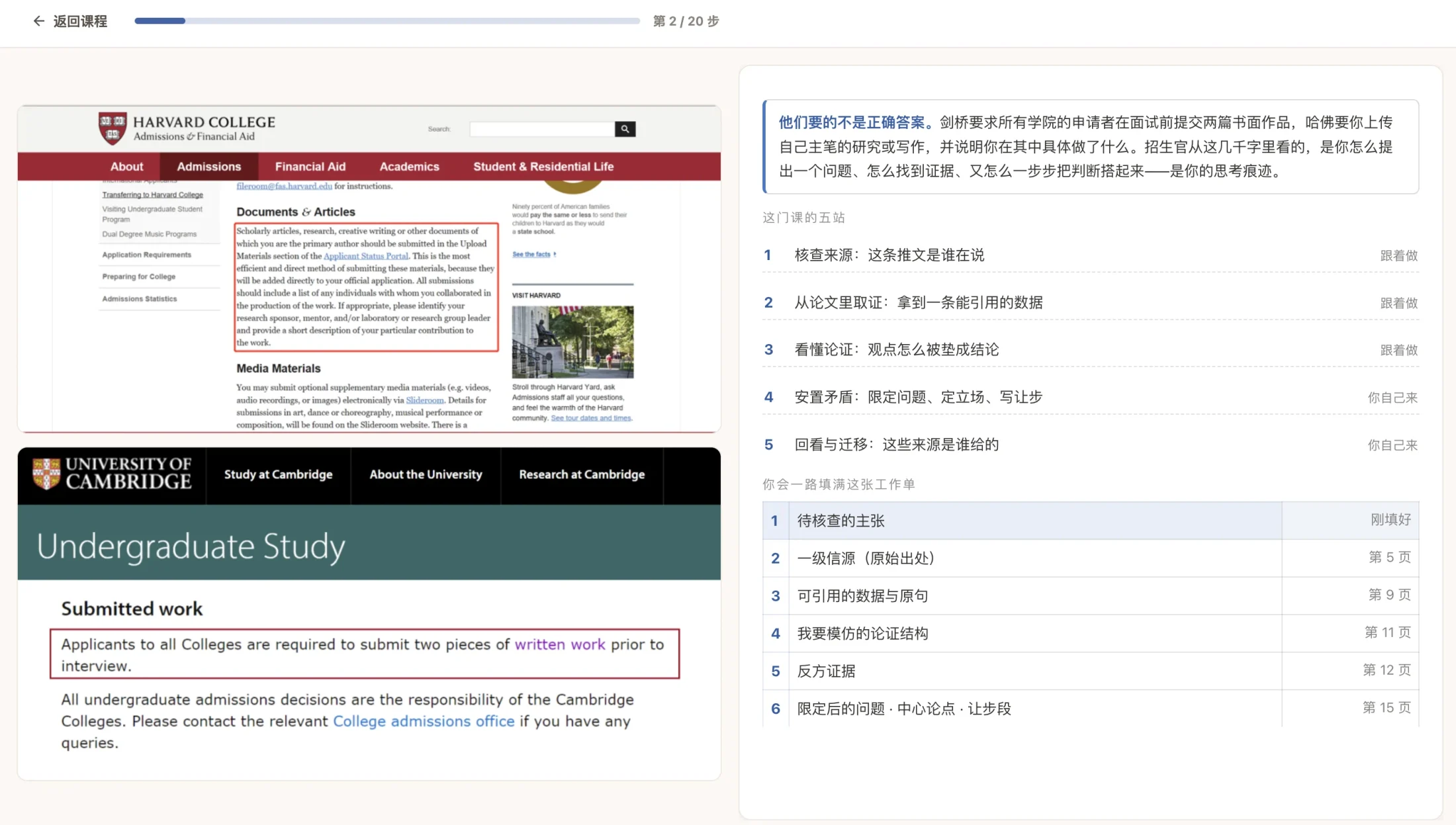
The course page: what Harvard and Cambridge really say about written work
02 / Framing

Talking the question through with the AI

Framing: the coach pressing a vague topic into an answerable questionPRODUCT RECORDING
Recorded product experience; interface language and appearance may differ from the current release.
03 / Research

Searching, and tracing what she finds

Tracing a claim from a second-hand retelling back to its sourcePRODUCT RECORDING
Recorded product experience; interface language and appearance may differ from the current release.
04 / Research

The rabbit hole keeps the detours

The rabbit-hole map: questions, the sources hung beneath them, and what is still unfiled
05 / Reading

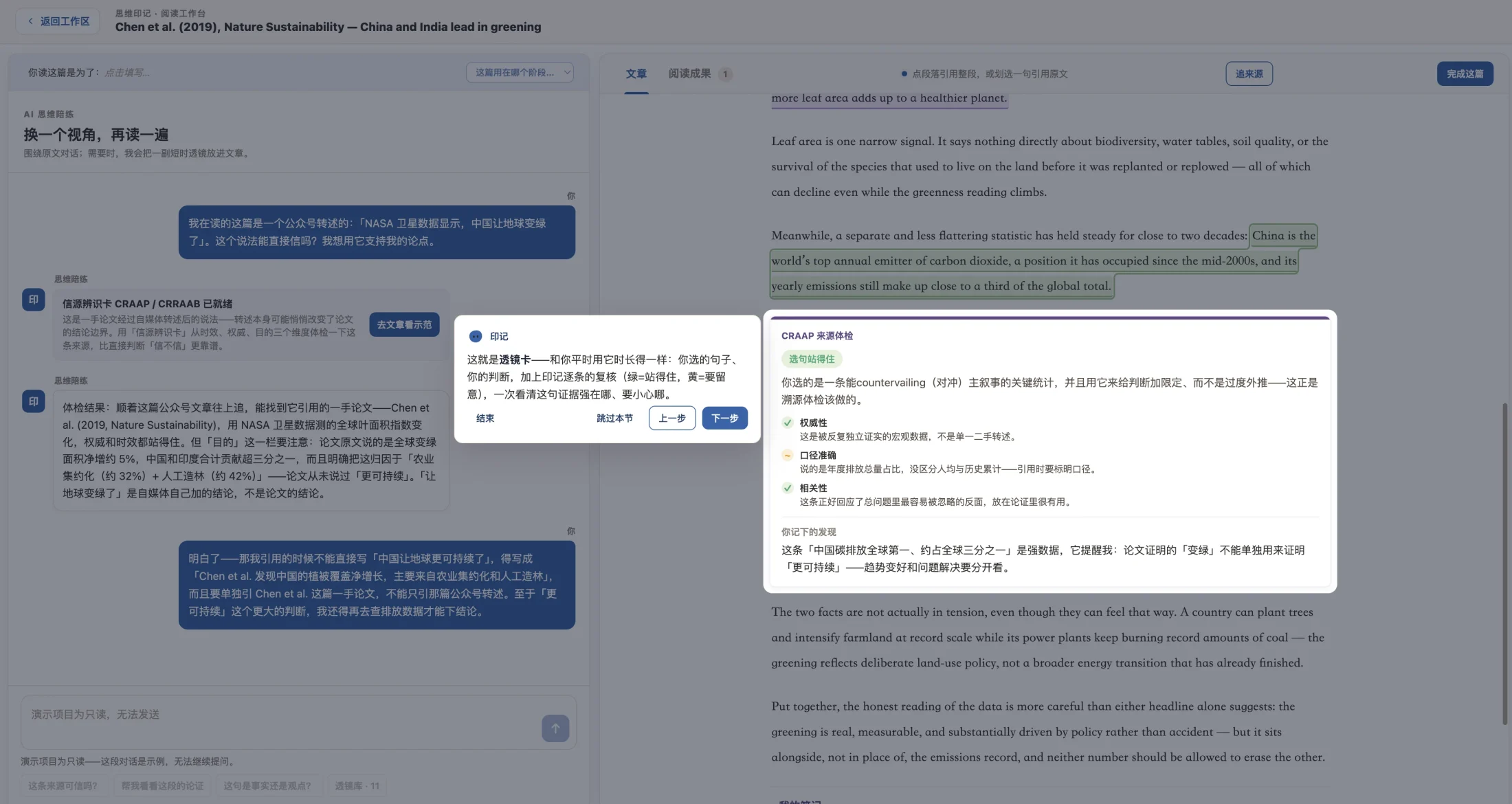
Reading the data, the claim and the source closely

The reading room: the source, a subject lens, and the tools for each passage
06 / Writing

The AI guides; every word is hers

The writing surface: a guiding card, her notes, the AI's annotations — and her own prosePRODUCT RECORDING
Recorded product experience; interface language and appearance may differ from the current release.
07 / Assessment

A report of the process, attempt by attempt

The report: milestones, counted figures, and the nine sectionsPRODUCT RECORDING
Recorded product experience; interface language and appearance may differ from the current release.
ASSESSMENT GROUNDED IN THE PROCESS

How deeply did they think? How independently did they judge?

The same source check can reveal how a student handles evidence and who initiated the check. Process assessment considers cognitive depth and intellectual autonomy separately, grounded in learning records.

Examine the quality of thinking

Cognitive depth

Framing the question · Evidence & sources · Argument structure · Perspective & bias · Feedback & revision · Reflection & metacognition

Examine agency in judgments and actions

Intellectual autonomy

Direction · Initiation · Boundary · Challenge · Signature · Truth first

Explore the assessment approach and full report ↗

Give supervision a concrete starting point.

Use learning records, thinking tools and process assessment to discuss evidence choices, revisions and independent judgment. Bring those records into supervision alongside classroom observations.

Explore the educator experience
THE NEXT CHAPTER OF LEARNING

Bring AI into learning. Keep students thinking.

Start with a reading, a piece of writing or a project. See how the Mark of Thinking can support your teaching.