Product / Curriculum & courses课程COURSES
Practice thinking in real situations.
Seven curriculum areas: AI ethics, AI use, source evaluation, historical evidence, multimedia reading, data literacy and self-exploration.
Course availability depends on the edition and course settings
Illustrative view
HOW LEARNING HAPPENS
Guidance, with room for independent judgment.
Each step involves a concrete action. Students’ choices, responses and revisions are part of the learning process.
- 01
Enter a concrete learning situation
Thinking methods students can use again
- 02
Use a tool and make a judgment
Records of responses and judgments
- 03
Reflect on the method and process
Learning connected to real tasks
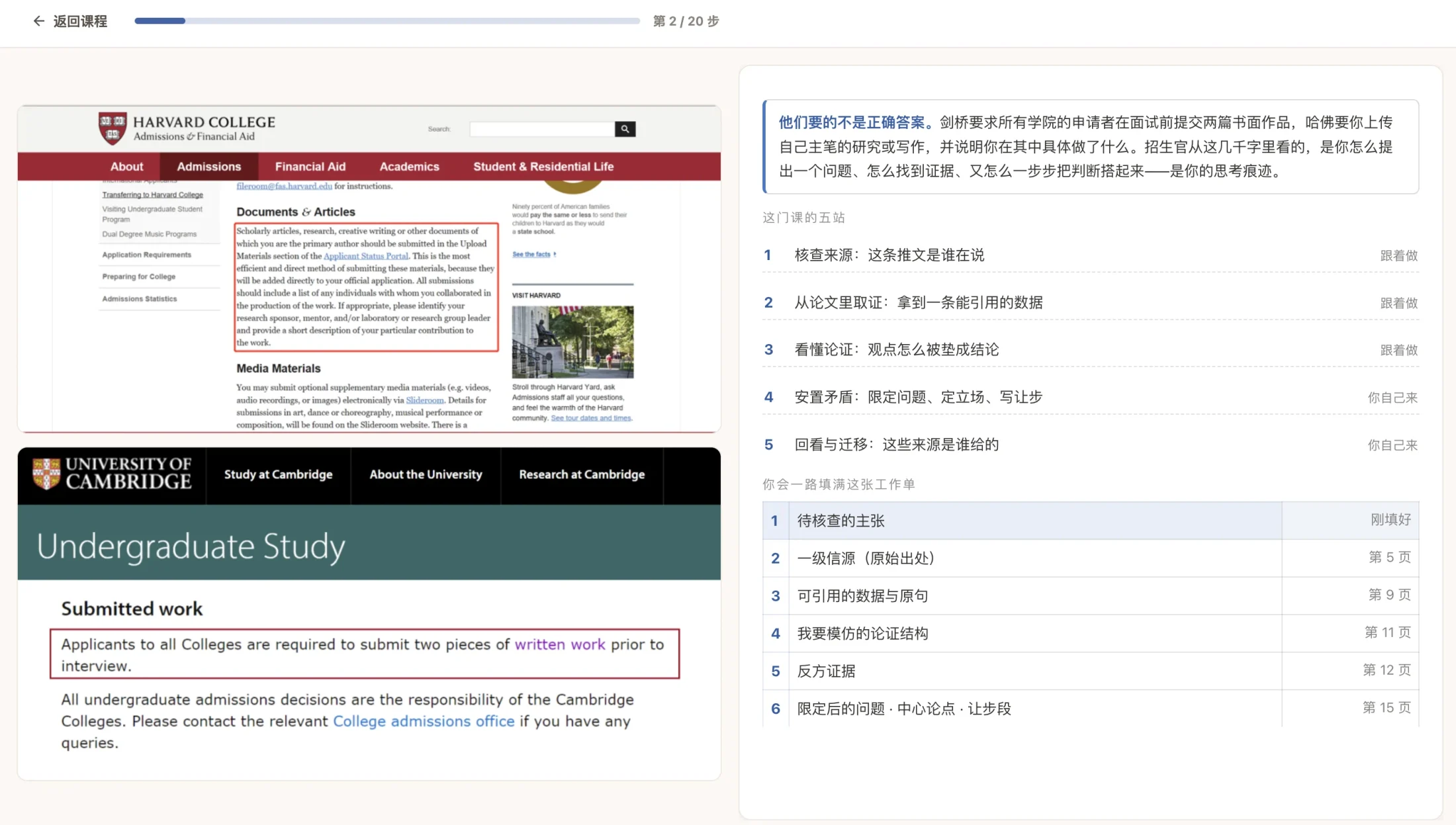
STEP INSIDE A COURSE
See a course unfold.
From understanding yourself to evaluating information. Swipe or choose a course to watch the learning process.
A CURRICULUM FOR THINKING AND PARTICIPATING
Seven curriculum areas. Questions that matter in the classroom.
Explore AI, information, history, media, data and the self. Each area connects learning situations, thinking methods and courses that educators can use within their teaching.
01
AI ethics
Who bears the costs of AI?
Examine training data, copyright, labour and energy to discuss the benefits, responsibilities and costs of AI. Give students evidence for discussing technological choices.
Explore this curriculum area02Using AI thoughtfully
How do you ask—and check the answer?
Practice prompt design, checking AI responses and explaining human and AI contributions. Ground AI use in a clear task and independent judgment.
Explore this curriculum area03Source evaluation
What makes this source worth trusting?
Start with a plausible claim and investigate its origin, interests and evidence. Apply CRAAP / CRRAAB and SIFT to concrete sources.
Explore this curriculum area04Historical evidence
What can this historical source establish?
Examine a source’s origin, purpose, content, value and limitations. Use context and contrasting sources to understand how historical interpretations develop.
Explore this curriculum area05Reading across media
How do images, sound and words shape judgment?
Read images, documentaries, short videos and generated media closely. Distinguish evidence from the effects of presentation.
Explore this curriculum area06Data literacy
Do accurate numbers guarantee a sound conclusion?
From chart axes and denominators to samples, comparisons and research methods, practice interpreting data with care.
Explore this curriculum area07Self-exploration
What is shaping my attention and judgment?
Use activities around inner parts, attention and perspective to help students understand their responses, choices and attempts to change.
Explore this curriculum areaTHE COURSE COLLECTION
Real questions. Practical thinking methods.
Browse topics and thinking skills. The courses available to a learner depend on their edition’s course catalog.
33 courses
 Disputes and source assessment
Put the dispute back on the evidence
Put the dispute back on the evidence
Students compare speakers in a climate dispute using a position spectrum and a perspective matrix, distinguishing their views, relevant expertise and evidence.
Explore courses in the product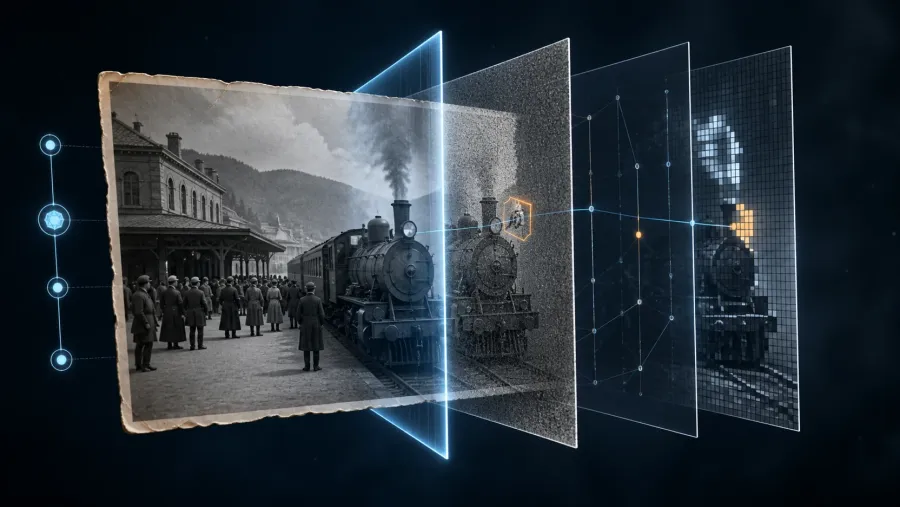 Verifying historical images
When AI rewrites history
When AI rewrites history
Students check the source, identities, story details and historical context of a photograph, identifying which claims the evidence supports.
Explore courses in the product Filtering and evaluating sources
The filter: from CRAAP to CRRAAB
The filter: from CRAAP to CRRAAB
Students compare CRAAP and CRRAAB to assess both source reliability and whether a source can answer their research question.
Explore courses in the product Science communication and denial tactics
Five moves of science denial: FLICC
Five moves of science denial: FLICC
Students use FLICC to examine two climate videos with different positions, checking both for selective evidence and explaining their judgments.
Explore courses in the product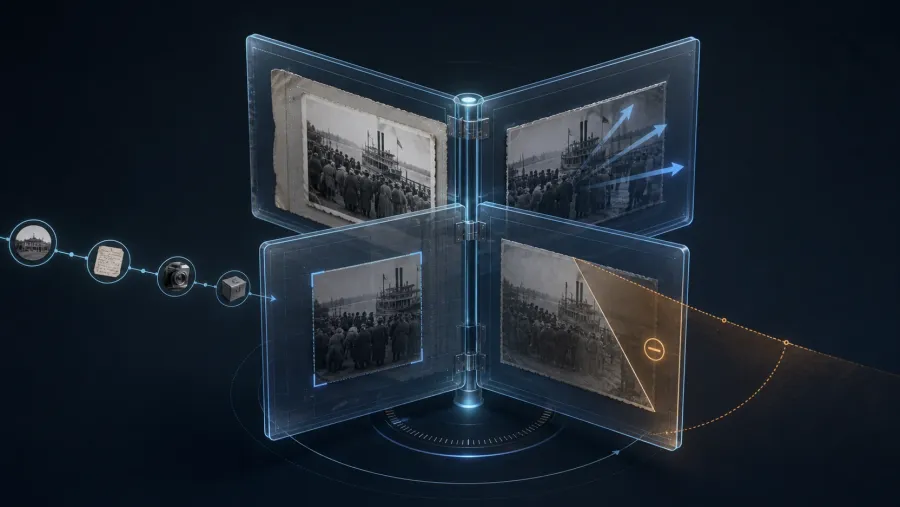 Historical source evaluation
One image, four reversals: OPCVL
One image, four reversals: OPCVL
Students reassess the value and limitations of a 1915 British recruitment poster as they learn about its creator, publisher and archival context.
Explore courses in the product Types of claim, and how to answer them
Fact, opinion, or value judgment?
Fact, opinion, or value judgment?
Students distinguish facts, opinions and value judgments, then choose appropriate checks: scope and samples, reasons, or evaluative criteria.
Explore courses in the product Synthesising public-issue information
The information-handling toolkit
The information-handling toolkit
Students examine a proposed casino on Boracay through tourism income, environmental capacity, governance and community interests, comparing priorities and trade-offs.
Explore courses in the product Multi-source checking and evidence writing
From one authoritative claim to verified writing
From one authoritative claim to verified writing
Students identify specific claims in a statement about short-term rentals in Venice, check multiple sources and use the evidence in writing.
Explore courses in the product Calibrating your own reasoning
Metacognition: how do I know I haven't fooled myself?
Metacognition: how do I know I haven't fooled myself?
Students review how they reached a judgment, checking premises, missing reasoning steps and perspectives they have not considered.
Explore courses in the product Comparability and conflicting evidence
Comparability check: four boxes before you judge
Comparability check: four boxes before you judge
Before deciding that two papers conflict, students compare their subjects, data, scope and measurement methods.
Explore courses in the product Synthesising multiple historical sources
Columbus: hero or villain? OPCVL across sources
Columbus: hero or villain? OPCVL across sources
Students assess sources about Columbus by examining authorship, audience, purpose and context, then compare the questions each source can help answer.
Explore courses in the product Academic writing on a sustainability question
SIFT lateral reading: from a post to an argued essay
SIFT lateral reading: from a post to an argued essay
A post claims NASA found the Earth greening, and that China and India are why. Does it go in the essay? Read laterally back to the primary source, see what the retelling lost on the way, and write it up as an essay that takes a position and can defend it.
Explore courses in the product From documentary material to a recommendation
Venice, three options: a defensible recommendation
Venice, three options: a defensible recommendation
Students compare three responses to overtourism in Venice, using documentary evidence to recommend a policy and explain its trade-offs.
Explore courses in the product Academic paper writing
Academic writing in English: structure to citation
Academic writing in English: structure to citation
Students plan an academic essay, develop paragraphs, check citations and describe their use of AI as they review their draft.
Explore courses in the product Calibrating certainty
How sure can we be? Calibrating the language of evidence
How sure can we be? Calibrating the language of evidence
Using Haltinner and Sarathchandra's paper on types of climate scepticism, the reading is not “what did they find” but “how sure are they of each finding”. Suggests, indicates, demonstrates: the certainty is in the wording.
Explore courses in the product Data and statistical literacy
When numbers want to fool you: three questions
When numbers want to fool you: three questions
Students examine axes, comparison groups, denominators and time intervals to understand how data presentation can influence interpretation.
Explore courses in the product Analysis and reporting results
Data analysis: from question to results paragraph
Data analysis: from question to results paragraph
Students choose methods and charts based on a research question, interpret the results and check whether each analysis addresses that question.
Explore courses in the product Academic search and source routes
Finding information: from the search box to a usable source
Finding information: from the search box to a usable source
Finding sources is not something you do once, when choosing a topic. It runs through drafting, writing and revision, and each stage wants a different kind: early on to understand the ground, later to build evidence, at the end to check.
Explore courses in the product ESG greenwashing evidence chains
Spotting greenwashing: the Tesla ESG evidence chain
Spotting greenwashing: the Tesla ESG evidence chain
Using Tesla’s impact report, students formulate checkable questions and compare evidence across environmental, social and governance issues.
Explore courses in the product Credibility of AI-generated media
Judging multimodal information in the age of generative AI
Judging multimodal information in the age of generative AI
Students practise checking reports, images and videos using original sources, provenance, metadata and contextual evidence about time and place.
Explore courses in the product Concept boundaries and evidential reach
Is esports a sport?
Is esports a sport?
“The IOC recognises esports as sport” and “Germany refuses to call esports sport” can both be true, because they are not saying the same thing. One body is classifying for administration, another is recognising an organisation, a third merely added an event to its own games.
Explore courses in the product Research design and method planning
Research methods: from question to a workable plan
Research methods: from question to a workable plan
Method is not the formatted paragraph in the paper; it is where a conclusion's credibility comes from. The course pushes it from “what tools I used” to why the evidence was gathered this way, how it was analysed, and how far the conclusion can reach.
Explore courses in the product Audiovisual language versus evidence
The image detective: whose side is the camera on?
The image detective: whose side is the camera on?
The course does not rule on who is right about the climate. It handles something else: the judgment that surfaces after you watch a film — how much of it came from the evidence, and how much from the lighting, the framing and the score.
Explore courses in the product Counter-evidence and bounding a claim
A concession you can delete was never a concession
A concession you can delete was never a concession
Students check whether a concession addresses relevant counterevidence and whether that evidence calls for qualifications or changes to their argument.
Explore courses in the product Dissecting arguments, spotting fallacies
The logic detective: taking arguments apart and building them
The logic detective: taking arguments apart and building them
It starts with a sentence that goes down easily, lets the student be persuaded for a moment, then turns back on it: was I convinced by the evidence, or pushed there by numbers, fear, authority, a switched term, or a false choice?
Explore courses in the product Framing in language, scanned
How language shapes thought: five tools for reading framing
How language shapes thought: five tools for reading framing
An experiment first: the same crime data, half the class told crime is a beast, half told it is a virus. The solutions split visibly — capture and punish on one side, diagnose and treat on the other. Watching it happen to yourself beats being told ten times that language steers judgment.
Explore courses in the product Interests and funding trails
Following the money behind a claim
Following the money behind a claim
Someone sends you a video: CO₂ is not a pollutant, fossil fuels took life expectancy from 30 to 73, so cutting emissions holds civilisation back. It has data, charts and a certain plausibility. So follow the money, and find out who paid for the argument.
Explore courses in the product Choosing a topic, writing a proposal
Topic and proposal: from a broad interest to a writable question
Topic and proposal: from a broad interest to a writable question
“I want to research AI's effect on employment” is not a research question; it is a topic. This course walks the hardest stretch of the road — narrowing, finding an angle, and landing on a question that material can actually answer.
Explore courses in the product Managing a long inquiry
Project management: a long inquiry as weekly sprints
Project management: a long inquiry as weekly sprints
Students divide a long-term inquiry into stages and weekly tasks, track decisions, dependencies and risks, and adjust their plan as work progresses.
Explore courses in the product Asking AI well: prompt design
Ask well and the AI answers well: writing prompts
Ask well and the AI answers well: writing prompts
Students tend to think a better prompt is a longer one — more role, more tone, more format. Here they ask about something they actually have to do: predict the answer, read it, then open the sources and check. The finding that matters is not that AI errs, but why fluent, confident prose quietly takes your judgment away.
Explore courses in the product Recognising your inner parts
The team inside you: IFS parts and an attention audit
The team inside you: IFS parts and an attention audit
IFS translated into a cast of inner characters a teenager can use. No test, no diagnosis, no lecture about screen time. It does something more basic: it rewrites “I am anxious” into “a part of me is anxious” — and that one rewrite moves you from the stage back into the audience.
Explore courses in the product Subject-object shift and immunity to change
Looking inward: three perspectives and immunity to change
Looking inward: three perspectives and immunity to change
Built on Kegan's subject-object shift and immunity to change, but deliberately without stage rankings, self-tests or verdicts on a person. It helps a student see one thing only: whether the change she says she wants and the thing she is actually protecting are the same.
Explore courses in the product Who paid for the AI: AI ethics
Who paid for the AI?
Who paid for the AI?
A short video about Anthropic puts training data, copyright, labour and energy in one frame, and it is easy to land straight on “AI companies sacrifice a lot of people”. The course does not ask you to take a side first. It starts from a simpler question: who is actually paying?
Explore courses in the productNo matching courses. Try a different keyword or focus.
THE NEXT CHAPTER OF LEARNING
Bring AI into learning. Keep students thinking.
Start with a reading, a piece of writing or a project. See how the Mark of Thinking can support your teaching.